


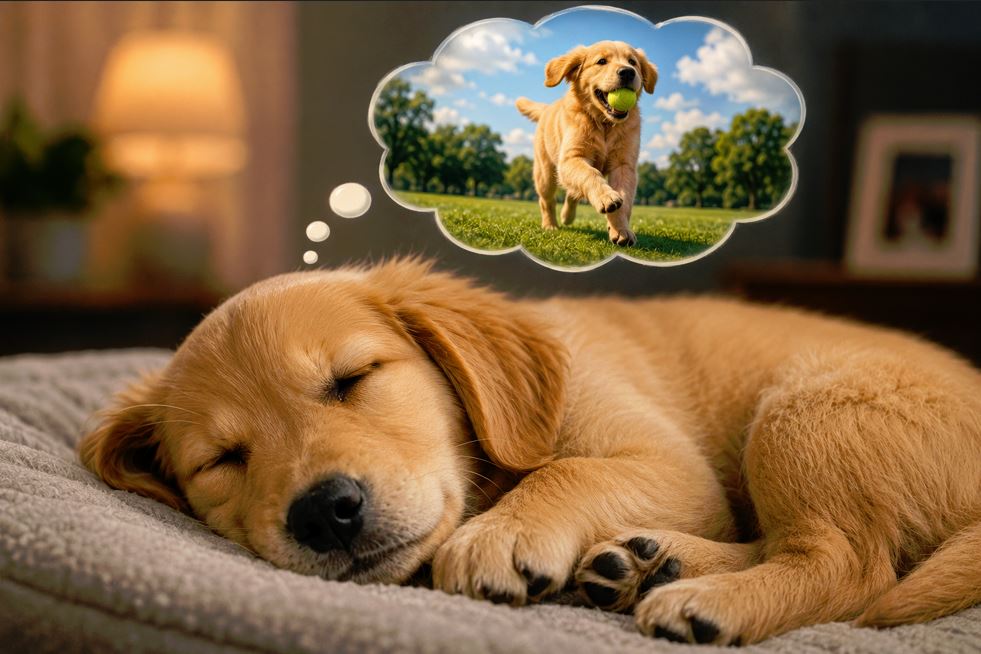
WHY DO DOGS DREAM?
If you’ve ever watched your dog twitch, quietly bark, paddle their legs, or softly whine while sleeping, you’ve probably wondered:
“Is my dog actually dreaming?”
According to veterinarians and animal sleep researchers — yes, dogs almost certainly do dream.
Modern science suggests that dogs experience sleep cycles surprisingly similar to humans, including a phase known as REM sleep (Rapid Eye Movement), which is strongly associated with dreaming.
Many experts now believe dogs replay memories, emotions, experiences, and daily activities while asleep.
That means your dog may actually be dreaming about:
- chasing a ball,
- playing at the park,
- running,
- eating,
- interacting with you,
- or even stressful experiences.
And in some cases, dogs may even experience nightmares.
DO DOGS REALLY DREAM? WHAT SCIENCE SAYS
One of the strongest scientific clues comes from sleep studies conducted on mammals.
Researchers discovered that dogs enter:
- light sleep,
- deep sleep,
- and REM sleep,
just like humans.
During REM sleep:
- brain activity increases,
- breathing becomes irregular,
- eyes move beneath the eyelids,
- and muscle twitching often appears.
In humans, this is the stage where most vivid dreaming occurs.
Because dogs show nearly identical neurological patterns during REM sleep, scientists widely believe dogs dream in a similar way.
Dr. Stanley Coren’s Theory
One of the most cited experts on canine psychology, Stanley Coren, explains that dogs likely dream about everyday experiences important to them.
According to his observations:
- Pointer dogs may dream about hunting,
- Guard dogs may dream about protecting territory,
- Family pets may dream about owners and routines.
Coren has stated that dreams probably reflect a dog’s daily life much like human dreams do.
WHAT DO DOGS DREAM ABOUT?
While nobody can directly “see” a dog’s dreams, experts believe dreams are heavily connected to:
- memory processing,
- emotions,
- instincts,
- and recent experiences.
A very active dog may dream about:
- running,
- swimming,
- fetching,
- agility training,
- or playing.
A working breed may dream about:
- herding,
- guarding,
- scent tracking,
- or protection work.
Puppies often twitch more intensely during sleep because their brains are rapidly developing and processing huge amounts of new information every day.
Older dogs may also show increased dream activity due to neurological changes associated with aging.
WHY DO DOGS TWITCH IN THEIR SLEEP?
Twitching during sleep is usually completely normal.
This happens because parts of the brain remain highly active during REM sleep while the body stays mostly relaxed.
You may notice:
- paw movements,
- ear twitching,
- tail wagging,
- lip movement,
- soft barking,
- growling,
- or rapid breathing.
Some dogs even appear to “run” while lying down.
Sleep researchers believe these movements may reflect dream-related brain activity.
CAN DOGS HAVE NIGHTMARES?
Many veterinarians believe dogs can likely experience bad dreams or nightmares.
This is especially possible after:
- stressful situations,
- trauma,
- anxiety,
- shelter experiences,
- accidents,
- or frightening events.
Signs of a possible nightmare may include:
- sudden crying,
- panicked twitching,
- growling,
- startled waking,
- or signs of confusion after waking up.
Dogs recovering from abuse or severe stress may experience disturbed sleep patterns more often.
However, experts warn owners not to panic immediately. Occasional movement or noises during sleep are usually normal.
SHOULD YOU WAKE A DOG THAT’S DREAMING?
Most veterinarians recommend not waking a dreaming dog unless absolutely necessary.
A dog suddenly awakened from deep REM sleep may:
- become disoriented,
- react defensively,
- or accidentally bite out of confusion.
Instead:
- gently call their name from a distance,
- softly make noise nearby,
- or allow them to wake naturally.
This is especially important for:
- rescue dogs,
- anxious dogs,
- senior dogs,
- or breeds with strong guarding instincts.
DO SMALL DOGS DREAM DIFFERENTLY THAN LARGE DOGS?
Interestingly, research suggests:
- small dogs dream more frequently,
- while large dogs may experience longer dreams.
For example:
- a Chihuahua may have short dreams every few minutes,
- while a Great Dane may have fewer but longer dream episodes.
Puppies also spend significantly more time in REM sleep compared to adult dogs.
This is similar to human babies, whose brains are rapidly developing.
HOW LONG AFTER FALLING ASLEEP DO DOGS DREAM?
Most dogs enter REM sleep roughly:
15–20 minutes after falling asleep.
That’s usually when owners begin noticing:
- twitching,
- rapid eye movement,
- leg paddling,
- or quiet vocalizations.
Dogs that sleep deeply and feel secure in their environment are more likely to experience healthy REM sleep cycles.
WHEN SHOULD YOU WORRY?
Dreaming itself is normal.
However, you should contact a veterinarian if your dog experiences:
- violent shaking,
- stiff body movements,
- loss of bladder control,
- prolonged muscle spasms,
- difficulty waking,
- or unusual behavior after sleeping.
These symptoms could indicate:
- seizures,
- neurological conditions,
- sleep disorders,
- or other medical issues.
The key difference:
dreaming movements are usually brief, soft, and irregular.
Seizures are often more intense, rigid, repetitive, and difficult to interrupt.
INTERESTING FACT: DOGS MAY DREAM ABOUT YOU
Researchers and behaviorists believe dogs likely dream about their owners frequently.
Because humans are the center of most dogs’ emotional world, experts think owners appear in canine dreams much like family members appear in human dreams.
So yes — your dog may genuinely dream about:
- cuddling with you,
- walking together,
- playing,
- or simply hearing your voice.
FINAL THOUGHTS
Science strongly suggests dogs really do dream.
Their brains process memories, emotions, experiences, and instincts during sleep in ways remarkably similar to humans.
Most sleep twitching, barking, or movement is completely normal and often simply means your dog is deeply asleep and mentally processing the world around them.
And while we may never know exactly what dogs see in their dreams, many experts believe one thing is certain:
dogs probably dream about the people and experiences they love most.
QUICK FACTS ABOUT DOG DREAMS
| Question | Answer |
|---|---|
| Do dogs dream? | Yes, experts strongly believe they do |
| When do dogs dream? | During REM sleep |
| Can dogs have nightmares? | Possibly yes |
| Is twitching normal? | Usually completely normal |
| Should you wake a dreaming dog? | Generally no |
| Do puppies dream more? | Yes |